CoreUnit in the field: TRL 7, version 1.2 and Craft
CoreUnit 1.1 has left our lab. We put it on the benches of our first beta customers, and we used it in the projects we deliver as a software house. The device worked great on boards and setups we did not build ourselves, and that lets us say that WisentWire is now at TRL 7.
This post covers what that means, what we learned along the way, what changed in CoreUnit 1.2 (already live), and Craft, the next piece of the platform.
What TRL 7 means for us
Technology Readiness Levels come from the space industry, which is close to home for us: TatraSpace is incubated at ESA Business Incubation Centre Poland (ESA BIC Poland). The scale is a useful yardstick for any hardware product. TRL 7 is the stage where a system prototype has been demonstrated in an operational environment. For us that means not a demo bench we set up for ourselves, but real projects, real boards and real teams.
For CoreUnit, that environment was two places:
- Our first beta customers. Embedded teams who connected CoreUnit to their own boards, on their own benches.
- Our own projects. As a software house we build embedded software for clients, and CoreUnit ran on those benches too. Using our own product on paid work is the fastest way to find out what it is still missing.

A first test within 30 minutes
Setup time is one of the first things embedded teams ask about, and rightly so: a test tool that takes a week to bring up is a tool nobody has time for. Our own estimate was under 30 minutes for a first board.
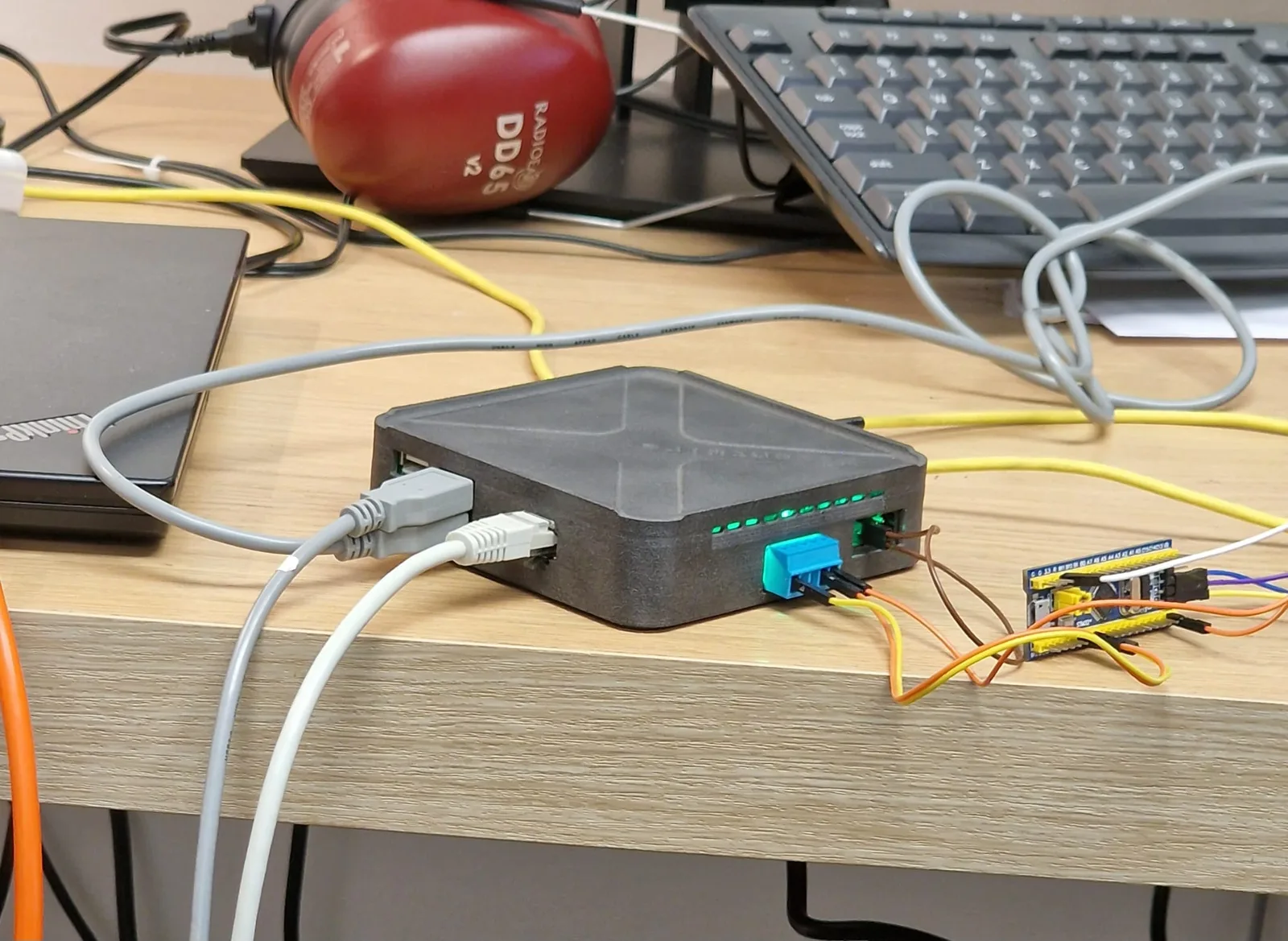
At the customer we were able to confirm it: an initial test was running on their board within 30 minutes.
What testing taught us
Testing in the field shows you things testing in the lab never will: how other people wire, use and lean on your product. Throughout the testing we collected improvements for the platform as a whole, not only the hardware. The first of them have landed in CoreUnit 1.2.
Hardened electronics
A unit on a working bench lives a harder life than one in our lab: more cables, more rewiring, more hands. We hardened the electronics in CoreUnit 1.2 so it is ready for that.
A new PWM pin and a new DAC pin
CoreUnit 1.2 adds two outputs next to the existing GPIO. Together they make it quicker to get equipment up and running, to inject faults, and to test actuators:
- PWM drives actuators directly. A fan, a motor driver or a servo can be exercised from the same test that flashes the board.
- DAC produces an analog voltage on demand. It can stand in for a sensor, then step out of range to show how the firmware copes with a fault.
CoreUnit 1.2 is already live. Everything else it does is on the CoreUnit page.
Craft: bring the setup you already have
One worry came up often in conversations with potential customers. They already have a test setup, and they were not sure they could bring their current equipment into our ecosystem. A bench is years of work, and nobody wants to start over just to adopt a new tool.
So we are preparing to release Craft. It lets you connect your existing test setup to the WisentWire platform, so the equipment you already trust works inside WisentWire instead of next to it.
Our goal with WisentWire has not changed: to make embedded hardware testing as simple as possible. Meeting teams where their bench already is, rather than asking them to rebuild it, is part of that. If you have a setup you would like to connect, tell us about it.
Thank you
To our first beta customers: thank you for the time and the honest feedback that come with being first. And to ESA BIC Poland: thank you for backing us through the incubation programme.
CoreUnit 1.2 is live, Craft is on its way, and the list of improvements is still growing.