Software for your own PC Launching 1 December
CraftWisent
Turns the Linux PC already on your bench, with its power supply, debug probe and dongles, into a WisentWire bench.
Free to startPlans from €19.99 / month. Linux only.


Remote hardware-in-the-loop (HIL) testing for firmware teams. Use the Linux PC already on your bench with CraftWisent, or plug in a CoreUnit, and your boards are reachable from your browser, your CI and your AI agent.
Sign up now. CraftWisent goes live on 1 December.

CraftWisent puts the bench you already have online. A CoreUnit does what a PC cannot: GPIO, PWM, DAC and signal generation. SensorHub and SensorSim stack on a CoreUnit when your tests need real or simulated signals.
Turns the Linux PC already on your bench, with its power supply, debug probe and dongles, into a WisentWire bench.
One maintained box that powers, flashes and talks to your board, and does what a PC cannot: GPIO, PWM, DAC and signal generation.
Reads analog and digital signals from real sensors into every test run.
Fakes sensor signals on demand: a voltage drop, a stuck reading, an edge case.
Serial console, power control and booking for every board, in one browser tab.
Explore the dashboard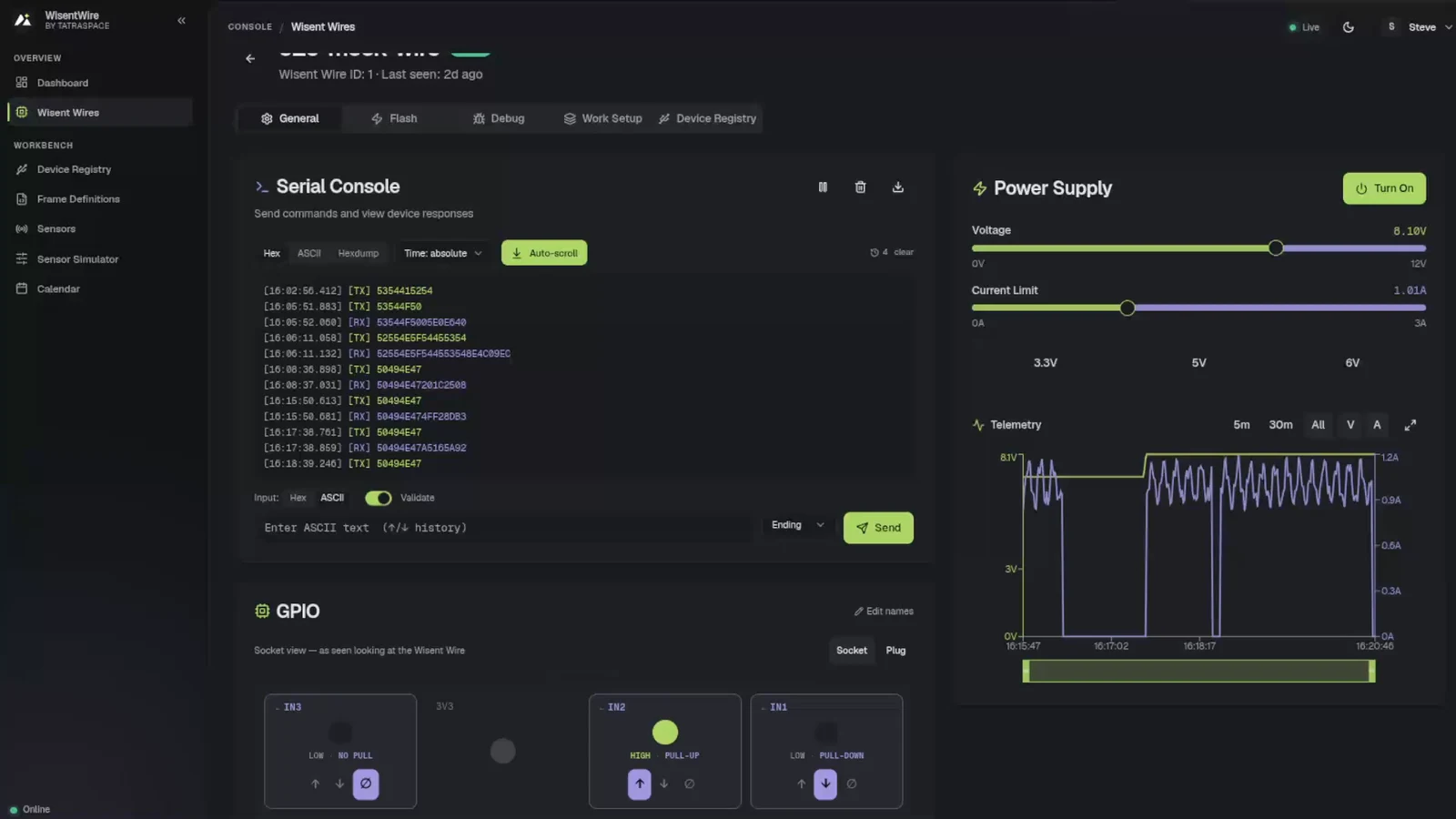
Not in the code. In everything around the board it runs on.
One hypothetical software house with eight engineers, three client projects and one lab, run twice: first on the DIY benches most teams build, then with a CoreUnit on each bench. Every total below is arithmetic you can check.
Software houses · CTO, head of embedded
Each DIY bench costs about 2 engineer-days and each CoreUnit bench 30 minutes, so the gap grows with every bench you add.
A senior engineer builds the first bench: a Raspberry Pi, a relay for the supply, a USB hub for the ST-LINK, a UART logging script and a VPN route. It works on day 2. The script is “almost” portable, so each new bench costs 2 more days, and its author maintains all ten as long as they exist.
Wire the board to the probe and supply as always, plug both into the CoreUnit, register them once in the Device Registry and pick RS-485 at 115200 in Work Setup. The board is powered, flashed and answering in the dashboard, no VPN needed on the cloud plan. The next bench reuses the frame definitions and GPIO names: ten benches, 5 h.
The kit
Plus the debug probe and programmable supply already on each bench.
| Item | DIY | CoreUnit |
|---|---|---|
| 1 bench | 16 h | 0.5 h |
| 3 benches | 48 h | 1.5 h |
| 10 benches | 160 h (≈ 20 days) | 5 h |
16 h is the top of what teams told us a basic setup takes, and DIY upkeep is not counted. The 155 h saved is €9,300 at €60/h: more than ten CoreUnits (€6,490 one-time) and a year of the Pro plan (€1,188, with 210 bench-days a month) cost together.
Software houses with client hardware · tech lead
Board logistics is the pain we hear most from software houses. With power, flash, serial and reset on the network, remote firmware testing replaces courier round trips: the board ships once, not once per iteration.
Monday, from home, you need to flash a bootloader fix. The board hangs and needs a reset, the colleague who could press it is in a meeting, and the office is a 1.5 h round trip. The client’s Rev B board in Bristol answers in phone photos of a terminal, then ships by courier: 3 to 5 days and customs each way.
Both Rev B boards sit on CoreUnits in your lab, and the client’s engineer, invited into the organisation, drives one of them from Bristol. From home, you power the board at 3.3 V, flash the fix, watch the serial console and pulse reset from a GPIO output. When a log is not enough, attach GDB through the probe on the bench.
The kit
Plus a debug probe and programmable supply per board. GDB attaches through the probe.
| Item | Without | With WisentWire |
|---|---|---|
| Board logistics per hybrid engineer assumption | 1 h/week | ≈ 0 |
| 8 engineers × 46 weeks | 368 h/yr (≈ 46 days) | ≈ 0 |
| Courier round trips per board revision | 2 to 4 | 1 |
368 h is 1 h × 8 engineers × 46 weeks: about €22,000 a year at €60/h, if every bench they use has a CoreUnit, not just the two in this story. The two CoreUnits here (€1,298 one-time) and a year of the Plus plan (€239.88, with 45 bench-days a month for two benches on 21 days each) cost €1,537.88: paid for after about 26 h saved.
Robotics and space · engineering manager
Wired once to a CoreUnit, the board stops moving between desks, so a handoff costs a 5-minute baseline flash instead of an hour of re-cabling and recovery.
A robotics team has one Rev C controller for two firmware engineers, a hardware engineer, a test engineer and the nightly CI. It moves between desks, and “who has the board?” fills the channel. A 16:00 experimental build costs the next person 30 minutes, and CI skips any night the board is away.
Firmware books the morning, hardware 14:00 to 16:00 and the nightly CI job its own slot, and while a slot is booked, nobody else can touch the board. Every session starts by flashing rev-c-baseline.bin from the firmware registry. The lab’s two benches without a CoreUnit go on the same calendar, so the team sees who is on which setup.
The kit
Plus the debug probe, programmable supply and adapters you already own, wired once.
| Item | Without | With WisentWire |
|---|---|---|
| Handoffs per week assumption | 6 | 6 |
| Re-cabling and baseline, per handoff | 1 h | 5 min |
| Lost in a 12-week phase | 72 h (≈ 9 days) | 6 h |
Six handoffs a week for 12 weeks is 72 handoffs, at 1 h or 5 minutes each: 66 h saved, or €3,960 at €60/h. Waiting while the board sits on someone else’s desk is not counted.
Software houses, electronics · tech lead, test engineer
Hardware CI that takes 2 weeks to build waits for an incident: at about 2 h, it becomes the project’s first merge request.
Hardware CI is due “once things settle”: a runner, a Pi to switch the supply, a flashing script that survives a reboot, a serial harness. Nobody has 2 weeks, so whoever is free checks the board by hand. In month 5 a bus-error recovery bug reaches the client, and the rig and its tests take 3 weeks.
The first merge request is the hardware CI pipeline: pip install wisent-wire-sdk, the sample test suite and one test that books the board, flashes the build and checks that it answers. It takes about 2 h, and every later feature ships with its test. Hardware pipelines run longer, but the same bug fails the build the hour it is pushed.
The kit
Plus your CI runner, debug probe and programmable supply.
| Item | Without | With WisentWire |
|---|---|---|
| Hardware pipeline in place | month 5, after the incident: ≈ 3 weeks (120 h) | day 1: ≈ 2 h |
| Tests written | one block, against 5 months of untested code | one per feature, as it ships |
| Commits between regression and detection | up to 40 | 1 |
The 3 weeks include a week of catch-up tests that the team with WisentWire also writes, one feature at a time, so the tests cost both teams about the same.
Any embedded team · QA, firmware engineer
Every run on a CoreUnit leaves behind the binary’s CRC32, a timestamped serial log and the power trace, so nobody has to reproduce a bug before looking at it.
QA, Thursday: the sensor node stops answering after 10 minutes on “yesterday’s” build, one of four. The supply sits wherever the knob was left, and the serial log is a PuTTY screenshot. After 3 h of re-flashing and guessing, the answer: the supply was set to 3.0 V for another board, below brown-out.
QA’s ticket names the unit and the time window: the CoreUnit flashed node_2_4_1.bin at 16:14, and the firmware registry shows CRC32 9b1e04c7, uploaded at 16:12. The power trace reads 3.02 V, not 3.3 V, and the serial log shows resets from 16:24, 10 minutes later. Closed in 15 minutes as “set point”, trace attached.
The kit
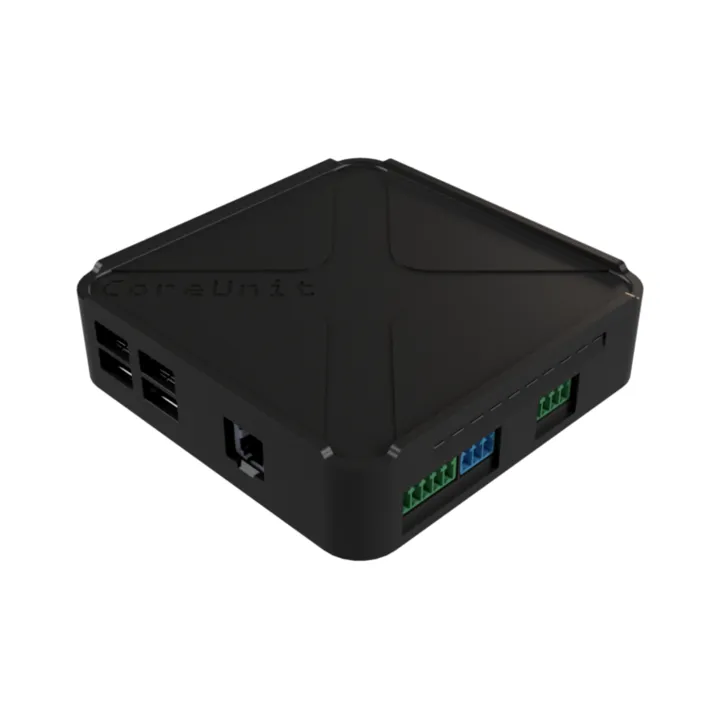 CoreUnit ×1the sensor node’s bench
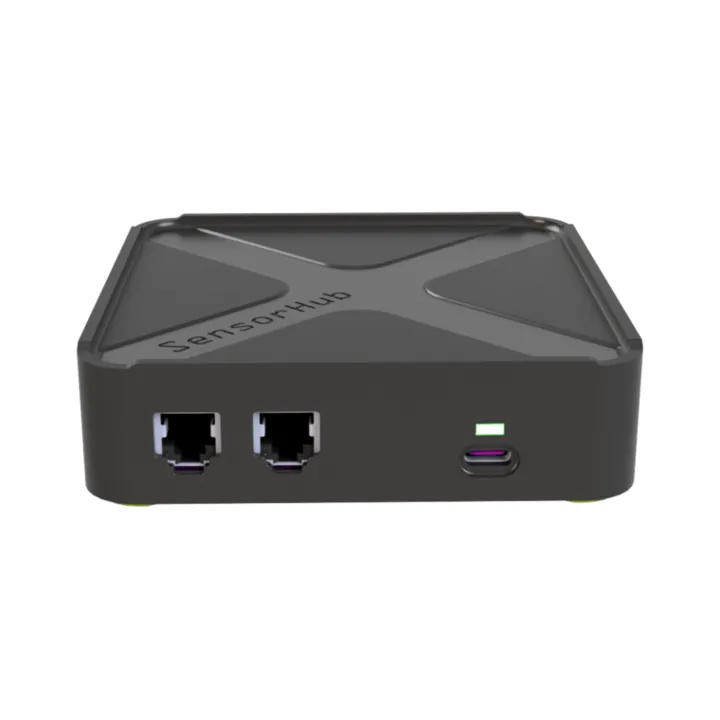 SensorHubOptional, in development: sensor traces
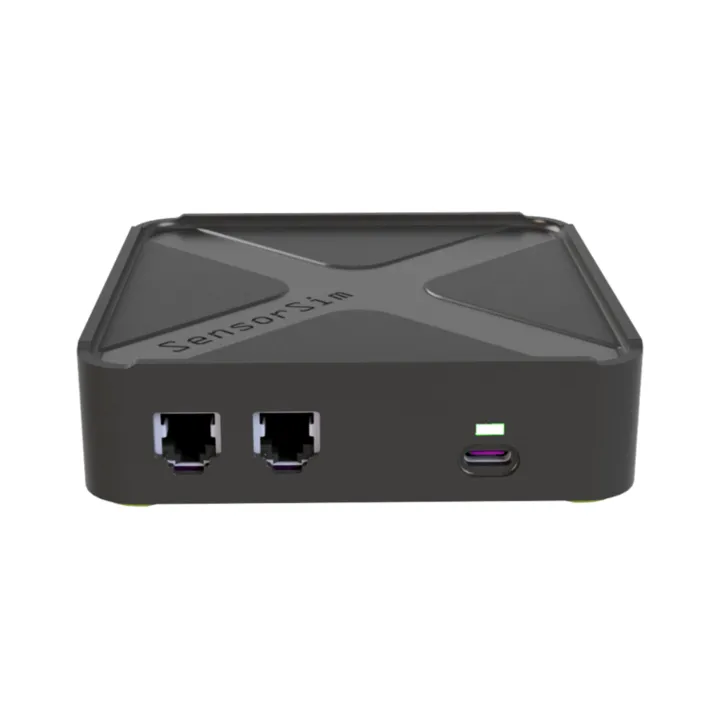 SensorSimNot needed
Plus your debug probe and programmable supply, its voltage and current now on record.
| Item | Without | With WisentWire |
|---|---|---|
| Reproduction hunts assumption | 2 a month, 3 h each | 2 a month, 15 min each |
| Time lost per year | 72 h (≈ 9 days) | 6 h |
72 h is 2 hunts a month × 12 months × 3 h. The 66 h saved, €3,960 at €60/h, is 5.5 h a month: enough to pay back a CoreUnit (€649) and a year of the Plus plan (€239.88, with 45 bench-days a month) in under three months.
Battery IoT and space · firmware engineer, test engineer
Power-up bugs reach customers because cold-boot and low-voltage tests run by hand once, if at all: with the supply under software control, they run every night.
Release checklist item 14: “verify boot at low battery”. Someone sets the supply to 3.0, 2.8 and 2.6 V, cycles it 5 times at each and watches the LED: 1 h, 15 cycles, nothing logged. A build that keeps a peripheral awake, drawing 30 mA more, still passes, and the field complains 3 months later.
A nightly job steps through 3.3, 3.0, 2.8, 2.6 and 2.4 V and cold-boots the board 40 times at each, asserting a bus reply within 2 s and idle current under 50 mA: 200 cycles in about 2 h of bench time. Fault paths run too: a sensor-ready line held low from a GPIO output, a malformed frame. The 30 mA regression fails the next nightly run.
The kit
CoreUnit ×1the nightly test benchSensorHubNot neededSensorSimOptional, in development: sensor faultsPlus a programmable bench supply, such as a Rigol DP832, and your debug probe.
| Item | Without | With WisentWire |
|---|---|---|
| Power cycles | 15 per release | 200 per night |
| Voltages covered | 3 | 5 |
| Engineer time per release | 1 h | 0 |
| Current logged | no | every run |
Supply readback has mA resolution: good for a stuck peripheral, not for µA sleep budgets. The current limit is set per test, so a wiring mistake trips the supply instead of cooking the only board.
Industrial and robotics on RS-485 · firmware engineer
A wrong CRC or byte order in a hand-typed frame costs an afternoon: a frame definition computes the checksum and validates the frame before it reaches the board.
The motor controller speaks Modbus RTU over RS-485, and everyone has a crc16_modbus() snippet from a forum. In one, the CRC bytes come out swapped, and the new hire loses an afternoon to a frame the device silently ignores. Known-good commands live on a wiki page of hex nobody fully trusts.
One frame definition holds the fields in wire order and a little-endian CRC-16/Modbus, and lives in the repo as YAML. Fill in ADDR 0x02, FUNC 0x03, REG 0x00CC and VALUE 0x0001, and Validate checks each field width before the console sends 02 03 00 CC 00 01 44 06. The CI test and an agent over MCP speak the same frame.
The kit
Plus an RS-485 connection to the motor controller.
| Item | Without | With WisentWire |
|---|---|---|
| Wrong-CRC or byte-order hunts assumption | 1 a month, 4 h each: 48 h/yr (≈ 6 days) | 0 |
| Onboarding a new engineer | a wiki page and a snippet | a definition and its saved commands |
48 h is 12 hunts × 4 h, or €2,880 a year at €60/h. Check our CRC: CRC-16/Modbus of 02 03 00 CC 00 01 is 0x0644, sent low byte first as 44 06.
Software houses using coding agents · tech lead
A coding agent that cannot touch the board needs a human for every flash and every log, while over MCP it runs the whole loop on its own.
You use Claude Code to write an RS-485 driver for an STM32: it edits, you build, flash with the ST-LINK, power-cycle and paste the serial output into the chat. Fifteen loops a day at about 10 minutes: 2.5 h as its hands and eyes. In between it is blind, and “it works” means whatever got pasted.
The project’s .mcp.json points at wisent-wire-mcp with an API key. The agent checks the unit is free, flashes with erase and verify, powers the board at 3.3 V with a 0.5 A limit, sends a frame, reads the reply and current draw, edits and repeats. You brief it at 9:00, review the diff and serial log after lunch, and let it run past 17:00.
The kit
Plus your ST-LINK, a programmable supply and a coding agent that speaks MCP.
| Item | Without | With WisentWire |
|---|---|---|
| Engineer time in the loop | 2.5 h/day (25 h) | 1 h/day (10 h) |
| Iterations outside office hours | 0 | as many as the agent needs |
Two weeks is 10 working days. By default, Claude Code asks before each MCP tool call: auto-approve belongs on a dedicated bench with a current limit set, not on the only prototype.
Any team with a Git history · senior firmware engineer
An intermittent regression with no test takes a senior engineer a day of bisecting, but an agent with the CoreUnit as its oracle can find the culprit by morning.
Ticket: “The gateway sometimes doesn’t come up after a power cut.” It fails about one boot in five, so each of 6 bisect steps over 40 commits is a build, a flash and 20 cold boots by hand: 45 minutes when nothing interrupts, which it does. A senior engineer’s day later: a culprit, still no test.
You write a one-paragraph brief: the symptom, 20 cold boots with READY in 2 s, the last good tag. Overnight the agent runs git bisect, power-cycling with set_power_supply and matching READY with wait_for_uart_rx. By morning a merge request holds the culprit (a shortened watchdog timeout), a proposed fix and test_boot_after_power_cut.py.
The kit
Plus your debug probe, a programmable supply and a coding agent or a script.
| Item | Without | With WisentWire |
|---|---|---|
| Senior engineer time | ≈ 8 h | 1.25 h |
| Regression test left behind | none | runs on every commit |
≈ 8 h is a full day: 6 steps × 45 min is 4.5 h before interruptions, and 1.25 h is 30 min on the brief, 45 on the review. Book the unit for the night, and auto-approve only on a dedicated bench with a current limit set.
Module vendors and space · founder, sales
A prospect who can drive your real module from a browser has an answer the same week, instead of the 3 weeks an eval kit takes.
A prospect in Toulouse wants proof your small-satellite interface module works with their protocol. The eval kit costs €400 and 4 days by courier, then 2 support calls because their supply and probe differ from the quick-start guide’s. An answer takes 3 weeks, and the kit rarely comes back.
Invite the prospect’s engineer into a demo organisation, book a 2-hour window on the module’s CoreUnit and send a link. From Toulouse they power it, flash the demo build, send their own frames over RS-485 and watch your regression suite run, while your engineer follows the same console on a call. One afternoon, nothing shipped.
The kit
Plus the module, its probe and a programmable supply. The prospect brings a browser.
| Item | Without | With WisentWire |
|---|---|---|
| Time to an answer | ≈ 3 weeks | same week |
| Hardware shipped (€400 kit + ≈ €60 courier) assumption | one kit, often unreturned | none |
| Support effort | 2 calls about their bench | 1 call on a known bench |
Ten kits a year cost about €4,600 with couriers and leave ten boards in the wild, against €649 once for one CoreUnit and about €240 a year for the Plus plan it needs. Ten 2-hour demos a year use about one bench-day a month, well within Plus. A separate demo organisation shows a prospect only the demo bench.
Illustrative stories about hypothetical teams, not customer results: one software house, except story 3 (a robotics team) and story 10 (a module vendor). Assumptions: €60/h loaded engineer cost, 8-hour days, 46 working weeks a year, 16 h to build a DIY bench and 30 minutes to set up a CoreUnit. Rows marked “assumption” are our least certain estimates. Paybacks use the CoreUnit price of €649 one-time plus the plan each story’s use needs, counting 21 bench-days a month for each CoreUnit in daily use: a year of Pro (€99 a month) for story 1’s ten benches, and a year of Plus (€19.99 a month) for stories 2, 5 and 10. Send us your numbers and we will run them with you.
Most teams try the first, price the second, and want something in between.
One plan per organisation. A bench-day counts only on a day you drive hardware, so register as many benches as you like: idle benches cost nothing, and every feature is on every cloud plan.
CraftWisentLaunching 1 December
€0no card
5 bench-days / month
For example, 1 bench on 5 days.
€19.99/ month
45 bench-days / month
For example, 3 benches on 15 days each.
€99/ month
210 bench-days / month
For example, 10 benches on 21 days each.
€249/ month
600 bench-days / month
For example, 20 benches on 30 days each.
Every account starts on the Free plan. To buy a paid plan, send an order request: we confirm by email with a quote and invoice, and nothing is charged on this site.
What is a bench-day? A bench is one CraftWisent or one CoreUnit. A bench-day is counted on any day you control hardware from that bench, once per bench, however many tests run that day. Watching is always free: logs, telemetry, the console and reservations never use one. For example, two benches driven on 20 days of a month use 40 bench-days, which fits Plus. A third bench that only streams logs that month adds nothing.
40 bench-days that monthFits Plus, with 45 a month
€649 one-time, uses bench-days from a paid plan
The box for what a PC cannot do: GPIO, PWM, DAC and signal generation. Comes with hands-on onboarding from our engineers.
Buy nowFree feature-limited
CLI, Python SDK and MCP on one machine. Single user, no web dashboard.
Start freeStart on the PC you already have, or order a CoreUnit and have an engineer with you for the last step.
Create a free account. The Free plan includes 5 bench-days a month.
One command downloads CraftWisent onto the Linux PC on your bench, and the PC shows up as a bench in your dashboard.
Power, flash and talk to your board from the dashboard, the SDK or an AI agent.
Pick where it runs, your benches, a plan and any sensor modules, and send an order request.
An engineer reviews your setup and confirms by email with a quote and invoice. Nothing is charged on this site.
The CoreUnits ship to you, ready to plug in.
Hands-on onboarding, and help designing your test rig if you need it.
A sumo robot on our bench in Wrocław. Good firmware passes the stop-check. Then we flash a faulty build, and the test catches it.
Playing loads the player from YouTube, which may set cookies. Privacy Policy.
Anything else? Email the team.
Under 30 minutes for a first board: connect a CoreUnit, wire up the target, and it appears in the dashboard ready to power and flash.
Our own demos run on STM32 and MSP430. Other targets, such as AVR and SAM or ESP32, go through probe-rs, OpenOCD or J-Link with the probe you already use: J-Link, ST-LINK, CMSIS-DAP, Atmel-ICE or a generic USB probe. Using something else? Ask us and we will check it.
A bench is one CraftWisent or one CoreUnit. A bench-day is counted on any day you control hardware from that bench. Watching is always free: logs, telemetry, the console and reservations never use one. You can register as many benches as you like, and idle benches cost nothing.
Not to start. CraftWisent turns the Linux PC already on your bench into a bench, with your own power supply, debug probe and USB dongles. It launches on 1 December. You need a CoreUnit for what a PC cannot do: GPIO, PWM, DAC and signal generation. It is also the only base for SensorHub and SensorSim, which do not attach to CraftWisent benches.
Linux only. It installs with a one-line command on any Linux machine. There is no Windows or macOS version.
No. On-premise runs the full app on your own servers and is quoted for your setup. Self-hosted is free and feature-limited: the CLI, the Python SDK and the MCP server on one machine, for a single user, without the web dashboard.
You order here and pay by invoice. Configure your setup and send an order request: we confirm by email with a quote and invoice. No payment is taken on this site. The Free plan and CraftWisent start with a sign-up, and on-premise is quoted for your setup.
What our first beta customers taught us, and what changed in CoreUnit 1.2.
ReadWhat makes firmware work uniquely hard, and what good looks like for distributed teams.
ReadWhat it really takes on a startup budget, and why it is worth it.
ReadFor teams building satellite modules, how automated testing becomes a sales asset.
ReadStart free with an account, buy CoreUnits or a paid plan, get a quote for on-premise, or spend 30 minutes with an engineer driving a real CoreUnit on our bench from your own browser.
€0 no card, 5 bench-days a month
€649 per CoreUnit, one-time
Free, with one of our embedded engineers